Past event
Beyond the Blue Marble
Summer Camp for Planetary Imaginaries
- When
- 18–24 August 2025
- Where
- Convent Santa Maria del Giglio, Bolsena, Italy
- With
- Baltan Laboratories
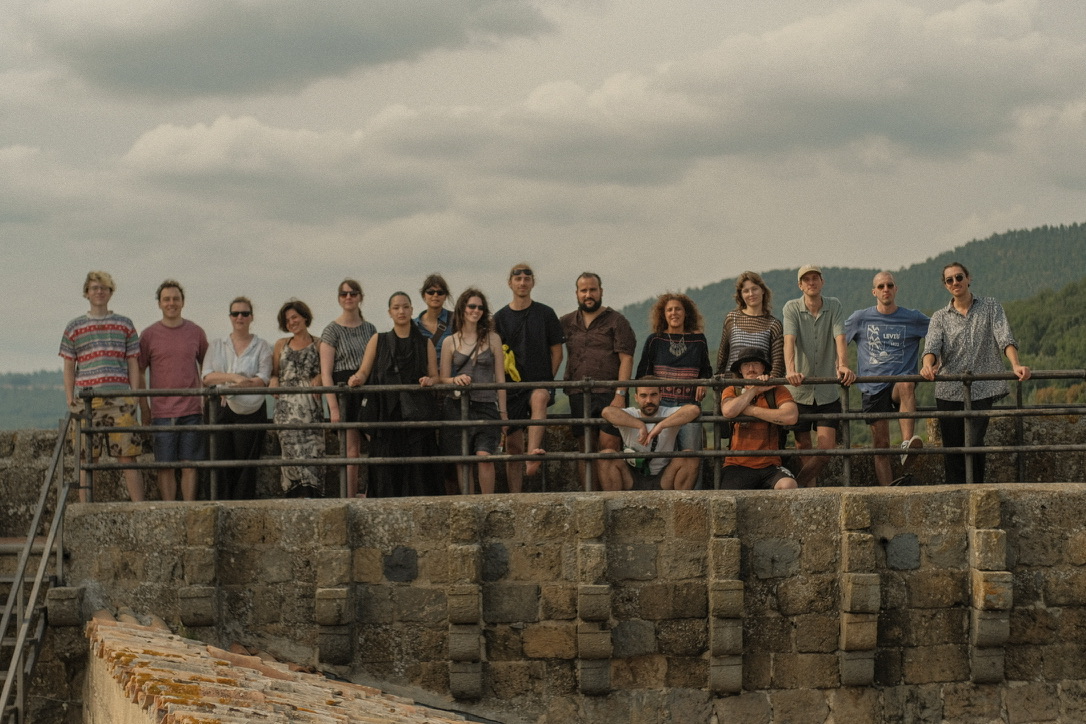
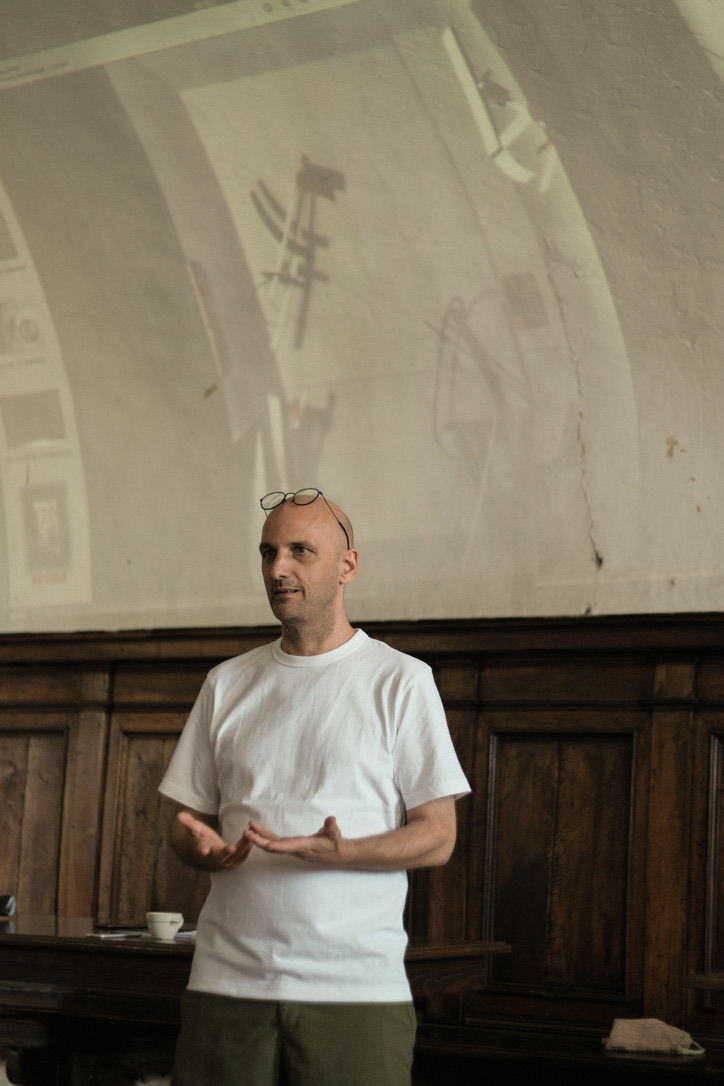
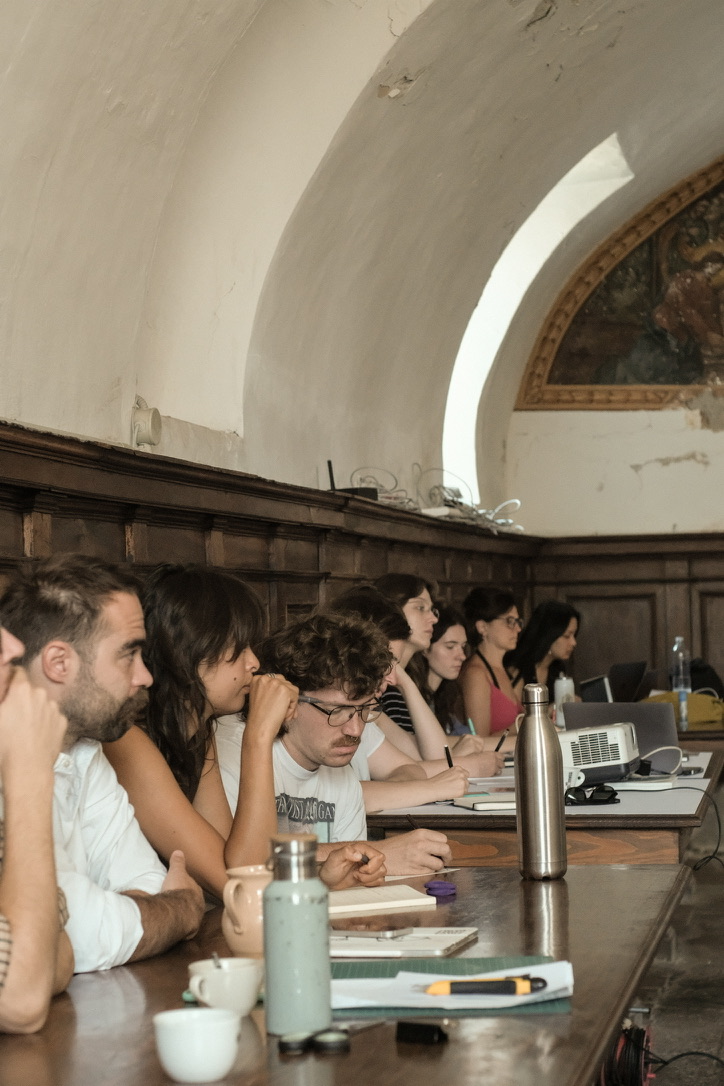
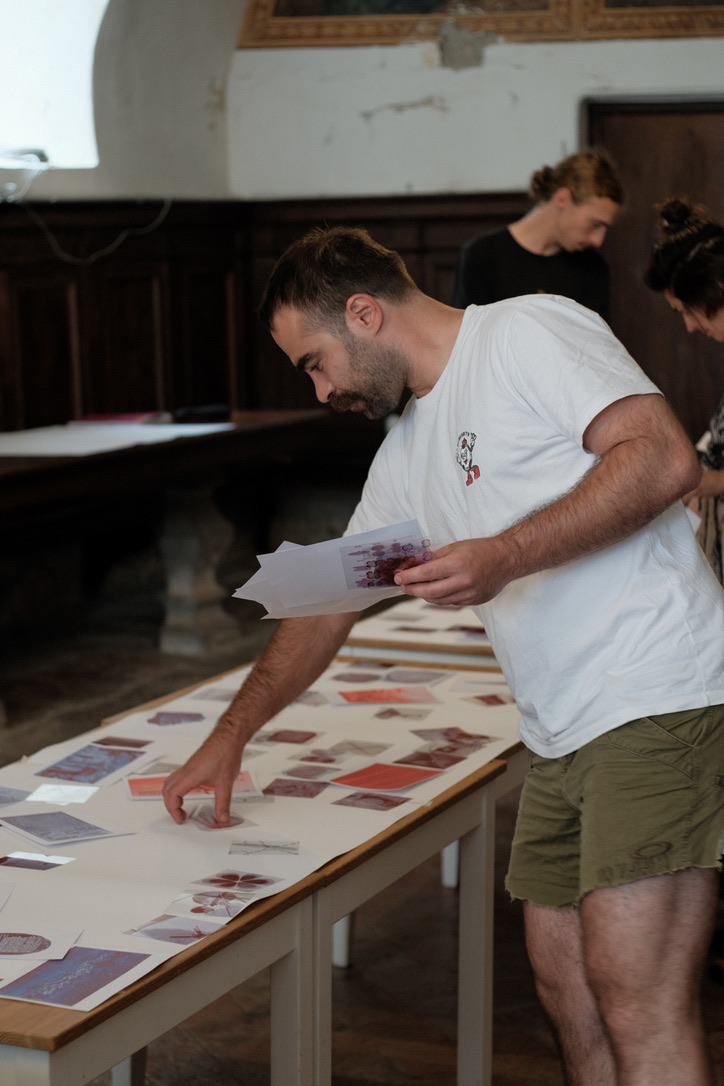
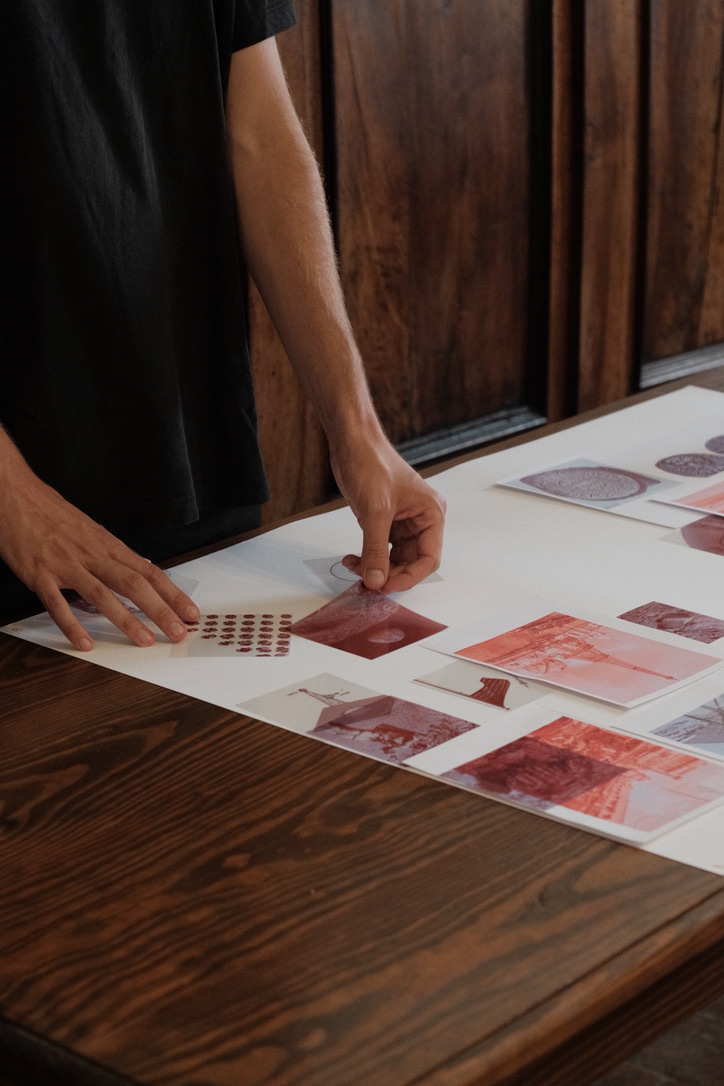
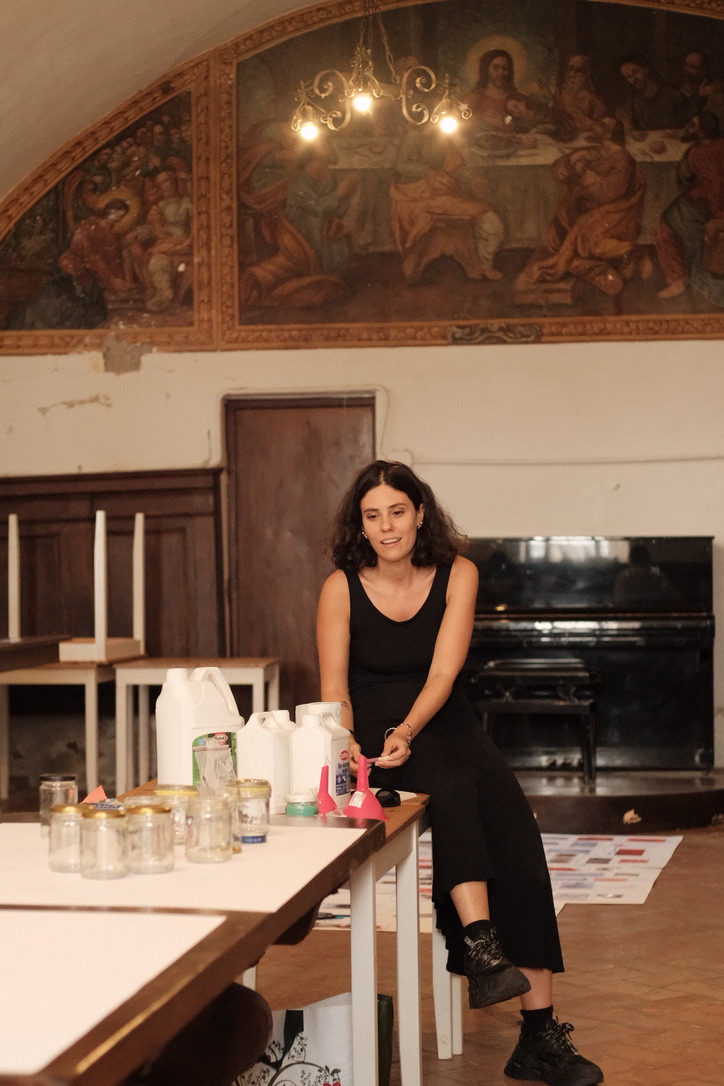
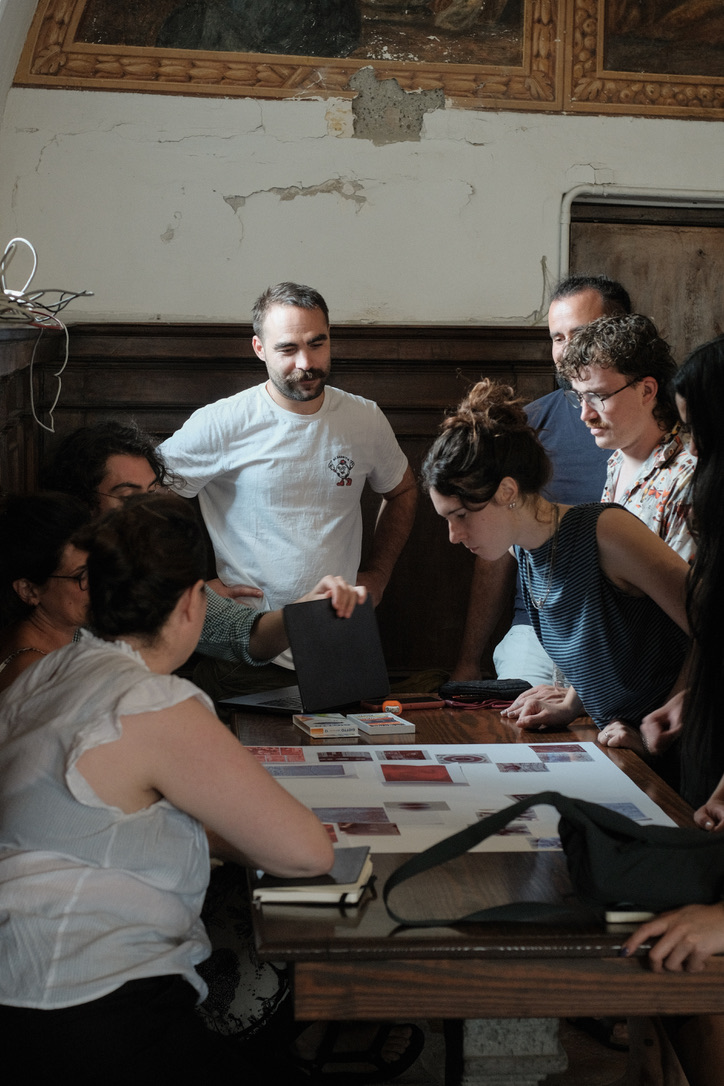
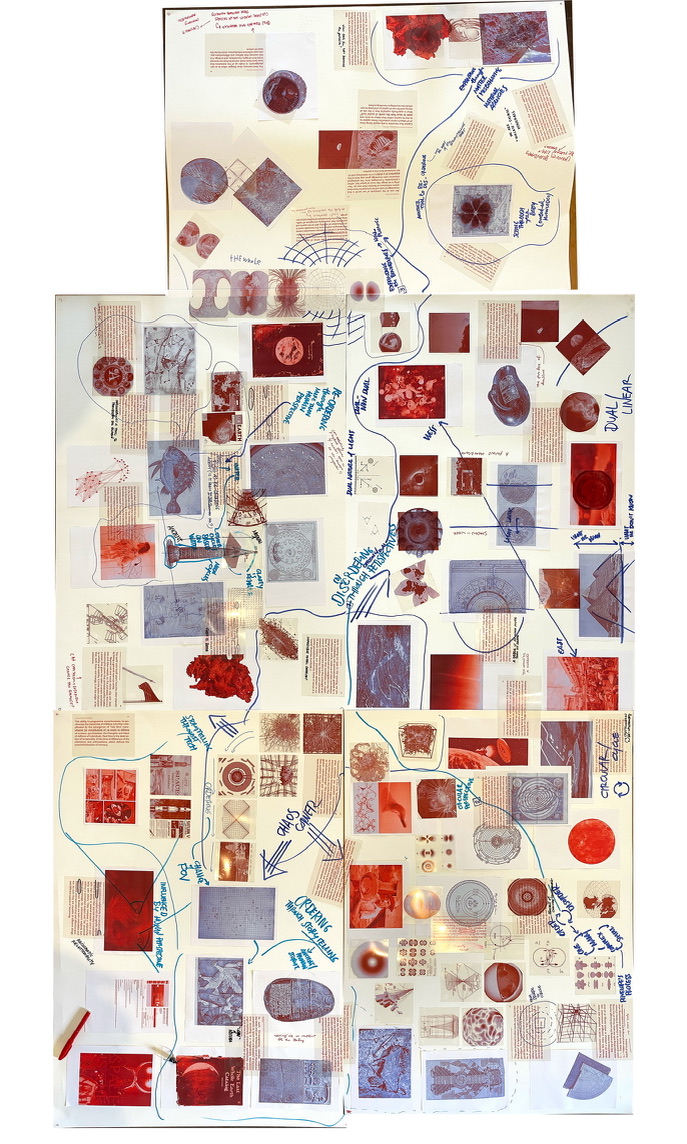
From 18 to 24 August 2025 the Chimerical Intelligence Lab and Baltan Laboratories brought together theorists and practitioners for a week of distributed thinking around Orvieto and Lake Bolsena, hosted in the convent of Santa Maria del Giglio in Bolsena. Taking the Blue Marble photograph as a starting point, we moved between lectures, a collective collage, experiments with living matter and excursions into the Etruscan landscape, and closed the week with installations and presentations made on site.
Day 1 · Arriving in Orvieto
The camp began as everyone arrived in Orvieto. We took the first day to explore the city and its history, guided by Stefano, who was mayor of Orvieto for 15 years.
Day 2 · Planetarity and collage
Our host Sabrina opened the day with a tour of the convent, its traditions and its history. Corrado Melluso, publisher of the Timeo imprint, then gave a lecture on different schools of thought around the notion of “planetarity”.
In the afternoon we set theory aside for a while and started our aesthetic collage practice, building associations and assemblages from historical and contemporary imagery and from work the participants contributed. The day ended with a lecture by David de Carolis on the Etruscan heritage and its significance in the region around Bolsena and Orvieto.
Day 3 · Chemical gardens
As the collaborative collage grew more and more layered, Laura Tripaldi, researcher at NYU Shanghai (@lauratripaldi) led a workshop on living matter based on an early 20th-century experiment. From silicate and salts we grew “chemical gardens”: structures that display many features usually associated only with life. Their silicate walls form semipermeable membranes, much like the ones found in the cells of carbon-based life forms such as ourselves.
In the evening we visited a land art exhibition on the shore of Lake Bolsena, at a place that held, and still holds, sacred meaning for the Etruscans.
Day 4 · Bolsena
The collage is complete, for now. The next step is to investigate it further through our own research and practices. On an excursion to the Museo Territoriale in Bolsena, the architect and museographer Cristina Fiordimela (@fiordimelacristina) introduced us further to Etruscan artefacts and culture. The thunderstorms stayed with us, a steady source of entertainment and awe.
Day 5 · Converging
With the help of Miha Turšič, who leads the Waag Space Lab, and the More-than-planet Atlas, we converged our ideas and inspirations into more concrete narratives and imaginaries, and started making work together for the closing exhibition and presentations.
Day 6 · Presentations
The last day brought together many of the ideas developed over the week, and over the months of preparation before it, as installations and presentations shared with each other. The contributions ranged from:
- a proposal for Dutch Design Week
- an ephemeral object of ice, rock and metal contemplating meteors and meteorites
- an exploration of Lake Bolsena as a body of water, through materials and artefacts the lake itself provided
- a storytelling device for retelling and reorienting myths, tales and pop culture
- a sensing workshop that went beyond our usual modes of cognition, experiencing the space as unmediated data and ending in a spontaneous outburst of noise, drumming and screaming
We are impressed by what came together in such a short production time. Thank you to everyone who put their time and money into imagining, organising and preparing this week, and to everyone who brought it to life by taking part.
The camp was organised by the Chimerical Intelligence Lab and Baltan Laboratories, with support from EPISTEAM and European funding (Horizon MSCA Staff Exchange).
The original call
This is the call for participants we published ahead of the camp.
Introduction
The Summer Camp Blue Marble: A View from Nowhere (working title) launched by the Chimerical Intelligence Lab and Baltan Laboratories is a call for theorists and practitioners who seek a space where their thoughts can be guided and connected to others. We are gathering a consortium of thinkers that extends beyond the so-called cultural field, acknowledging that objects, images, words and digits are produce everywhere, all the time, but appear to us as if they exist in their own episteme. This 7-days Summer Camp will propose methodologies to mediate conversation between different minds and/with technological artefacts. The open call is for everyone who feel the need to break apart what we take for granted: the material reality. Ideally, the selected participants would already matter of interest that resonates with the proposed framework. We would there explode their object of research and retriangulate the broken pieces all together. The Summer Camp can be seen as an opportunity to de/re/contextualise their work within material, symbolic and philosophical discourses.
We are designing a space for inter/trans/multi/infra/un-disciplinary thinking. Participants will attends to online and onsite talks before and during the camp, but also engage with the local landscape of Tuscania, an Italian village carrying the memory of the Etruscan civilisation. In deed, the thoughts experiments that will be conducted “indoor” will join us “outside” as an intellectual inventory to challenge our view and experience of the (seemingly) surrounding material we will encounter.
Theoretical Framework
Two years after the launch of the Soviet Union’s satellite Sputnik, the first man-made object to orbit the earth in 1957, Hannah Arendt defined this event as the most significant in human history, “second in importance to no other, not even to the splitting of the atom.”[1] NASA’s Apollo 18 mission in 1972 was the United States’ expensive and powerful answer to Sputnik in the battle to prove that one hegemony’s economic system was superior to the other. Apollo 18 was a double-first. It was the first mission to land on the moon and the first to capture an image of the planet in its entirety—the famed Blue Marble photograph. In this protracted ideological war that defined a world order, technology shifted the weaponry of domination from a physical force that effects harm on skin itself towards a form of absolute persuasion. People could be persuaded into collective awe and fear—unified, synchronized, and thus governable—without the need for skin to experience violence directly. Arendt draws a direct correlation between the cosmological object born from a mediated battle of economic ideology and the harnessing of a power that bonds the faith of the living at planetary scale.
The capture of the entire planet in a single image grounded a totalized approach to ecological issues. If today’s governance by numbers does not finds its roots in extraterrestrial point of view, satellite imagery certainly participates in the solidification of the “God’s eye view” logic. Governance — not just in the sense of policy by nation states in collusion with corporate entities but also personal, socialized paradigms of behavior — shall hence be mediated by objective technics. Hyperobjects such as global warming are phenomena spread so complexly over space and time that they become unperceivable, indecipherable, and, thus, ungovernable by any body, individual or collective. Numerical data serves to conceptualize global warming into an object, abstracting it from a multi-dimensional circumstance into a flat concept that does not need to be experienced and can, simply, be manipulated. Between reductions of representation and indecipherable complexity, the question of what is technology emerges as central.
The atomic bomb may have ended WW II, but aerospace technology was necessary for this war to continue, only, in ideological form. The bomb was a physical weapon and the Blue Marble is an imaginary/symbolic one. A war of symbols justifies the imposition of capitalism as we know it. The physical and imaginary are both oriented towards totalization, but their form of domination is different. The unification of the globe into a single object, binding together the fates of all who inhabit it. Subjectivity is removed from the equation because this view from nowhere is a gaze that universalizes. The human subject is forced to give up their agency to scientific arguments that construct an authoritarian ecological governance. So eco-crisis is not just a disaster that happens to the environment, a landscape. It also manifests as an internal crisis of agency for and of the subject.
The Blue Marble gives texture to the long journey of modern science that functions ‘objectively.’ In the endeavour of erasing subjectivity from the equation. The now hegemonic regime of truth operates by abstracting so-called knowledge from its material substrate. The mathematisation of institutionalised science intends at losing any sort of biases and reach universal truth by producing a view from nowhere. More than half a century after the first picture of the Earth, the image of “one planet” has sedimenting in the collective imaginary. Nowadays, the amount of technologies of imaginaries have proliferated in tentacular forms. Many are assembled to compose the aesthetic argument for the Anthropocene. In a global synesthesia, digits and images are triggering affects at distance, within the subjects. Descriptive cognitive assemblages turn into prescriptive apparatuses. This machinic phenomenon creates forms of subjectivities, which, recursively, nurture the underlying economic (postpolitical?) dynamics.
Reclaiming Agency
The dawn of humanity is fundamentally linked to the creation of myths and cosmologies that order the world before our eyes. Those systems of symbols seemed to be embodied in artefacts (such as cave paintings, clay tablets, wood engravings, stone sculpture or paper lithographies) until they turned into technological objects that extract physical laws from the material world and aesthetise them into new cosmological truth (we can think here of optic telescope, radio antenna, particle accelerator, gravity wave detectors). The modern means of cosmological engineering are so distant from the human experience that it can seem ‘reasonable’ to step aside of such fundamental conversation. One entry to the question of small scale research’s legitimacy is to move around the cursor pointing at where do imaginary tools stop being descriptive and start being prescriptive.
To tackle this question we will need to escape the ontological logic of distinguished subjects and objects and recognise the deep coevolution of individual consciousness and shared external memories. In other words, humans crafting of their environment had always recursively shaped their brains and common imaginaries.
Here we can begin to formulate an approach to reclaim agency in the engineering of plural cosmologies. We will first dissect the making of modern iconographies such as the Blue Marble. With a self-reflexive mindset, we will see how we are hence picturing the concepts that are relevant for the rhetoric we need. The process of de/re/composing of aesthetic concepts will serve us in addressing the world of objects ‘standing’ before our eyes. This method may empower us into engineering cosmologies “with our owns hands,” at our own scale, with the tools at our disposal and with the reach we have.
Proposal
We propose a trajectory to unfold the design of the contemporary human condition starting from the Blue Marble image. Our approach is to consider the Blue Marble as a technology of imaginary. The method we will pursue consists of exploding in space and time the broader infrastructures, historical contexts, economic blueprints, political agendas, ideological constructs, knowledge architectures and subjectivity productions necessary for the concurrence of the conditions giving birth to the Blue Marble. This process is an inquiry into the technological ontogenesis of the Anthropocene imaginary. The Summer Camp will take place in Italy. Over the course of 7 days, the participants will engage in workshops at the confluence of texts and images. The proposed methodology will function as a hypersynaesthesia, generating concepts that defy disciplinary enclosure. Not in spite of but thanks to the diversity of interfaces or artefacts that participants are comfortable to use in their personal intellectual journeys (be them words, numbers, diagrams, images, tools or gestures), the multiple back-and-forth between different domains and registers will assemble into new chimeras. In the manner of an ‘exquisite corpse’, we here acknowledge the cognitive agency of the tools and technics mediated our conversations. The members of the Lab will offer a curated common ground only so the participants can let their own questions and intuitive ideas find other connections and contextualisation in this space of distributed thinking.