The Chimerical Intelligence Lab (CI-Lab) is a platform for distributed thinking. The Lab aims at conducting non-linear thought experiments that manifest themselves in overlapping study, research and working groups. Acknowledging the entanglement of all layers of reality, it is necessary to reattribute agency to the symbols and artefacts involved in every thinking process.
Chimerical Intelligence
The intellect doesn’t occur in an idealised void but emerges from the dance of multiple material phenomena. In response to this statement, the CI-Lab operates by hosting hypersynaesthetic workshops, where people and technologies such as words, digits, images, tools and materials function in concert to generate serendipitous outcomes.
Mirroring computational matrixes of so-called “artificial intelligence”, the Lab cares about involving human subjectivity within the practice of creating new objects of knowledge – in contrast to the current dynamic of outsourcing the articulation of thoughts to automated systems, where users are not apparently required to think.
The CI-Lab produces graphic essays and cinematic lectures, but its main ambition is to challenge the very people who engage in it. It is through the participants that we hope to poke the existing intellectual order, ecosystem of thoughts and knowledge architecture that define the imaginaries of this fundamentally ecological universe.
Position
Addressing issues at planetary scale is as much a necessity as a danger. While macroeconomics operate by homogenising value on Earth, macropolitics hopes to put in conversation the diversity of situated voices.
The question is: do we have the tools to reconcile the local and the global, the embodied and the abstracted, the subjective and the objective?
Every representation of reality is flattening its infinity of dimensions into a single layer. Since the present exists in correlation with the past and future, all conscious selves and nonconscious beings alike shall be understood as spread in time, and hence, in space.
If we acknowledge that knowledge making always functions by reduction, trying to bypass this violent act leaves us with the possibility of overlapping different perspectives, over and over again.
Approach
In the CI-Lab, we experiment with the various layers of reality that we choose to collapse onto a sheet of paper. We operate by exploding the objects of study and decompose them into the assemblage of force fields from which they originate.
This practice opens up other logics of emergence. Mapping out the non-linear genealogies draws constellations of things that decentralise the human. Anthropocentrism is a useful and ethical paradigm as long as it is flexible enough to conduct Copernican turns at will.
We proceed by shifting the gravity center of our compositions and observing the rearrangements happening in coherence with these moves. The passage of one focal point to another applies one cosmological order onto an apparently unrelated subject.
This approach reveals not only new schemes of causality but logics of coexistence – which implies the possibility to recompose systems of ethics, politics and spiritualities.
Method
The CI-Lab is a nomadic space that manifests itself in diverse instances that function as intertwined working groups and study groups. We use visual, physical, aesthetic practices to mediate and canalise discussions that occur in separate domains, but also to catalyse these thoughts. The artistic DNA of the CI-Lab contributes to rendering visible, giving texture to, sculpting and materialising alternative concepts. This is a laboratory to synthesise alternative objects of knowledge – which typically refuse academic disciplines’ enclosure.
In the manner of exquisite corpses, we superpose and assemble symbols that are produced in distinct registers. The resulting chimeras agglomerate fragments of reality scattered through parallel worlds. They work as starting points for pluralistic discourses, each including a different configuration of subjectivities.
In practical terms, we harvest archival images, contemporary visual documentation, created artworks, scientific illustrations, technical diagrams and personal sketches to make gigantic collages. We then put these tentacular figures in conversation with a spectrum of philosophical, theoretical, historical and journalistic texts. The capillarity of the collage leads to diverse intellectual branching.
Instances
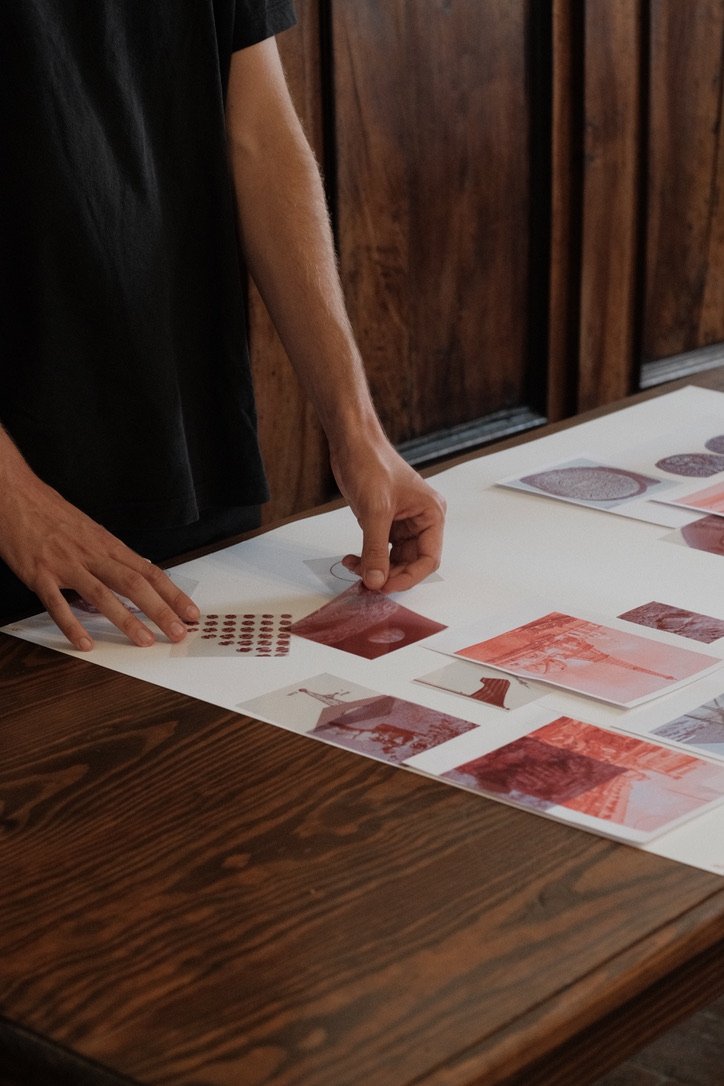
Hypersynaesthetic workshops
The protocols we follow in our workshops are designed to provide participants with the capacity to influence the trajectory of the experiment toward their interests and fascinations while integrating some level of randomness and serendipity. In some phases, it is about following our aesthetic intuitions, in others, it is about forcing connections between the visual products and seemingly unrelated texts. The back-and-forth between image and texts makes us navigate some of the visual cultures and bibliographies that can help address the topics. Following a dynamic architecture of hyperlinks, the recursivity between images and texts generates lines of thought in a synaesthetic fashion.
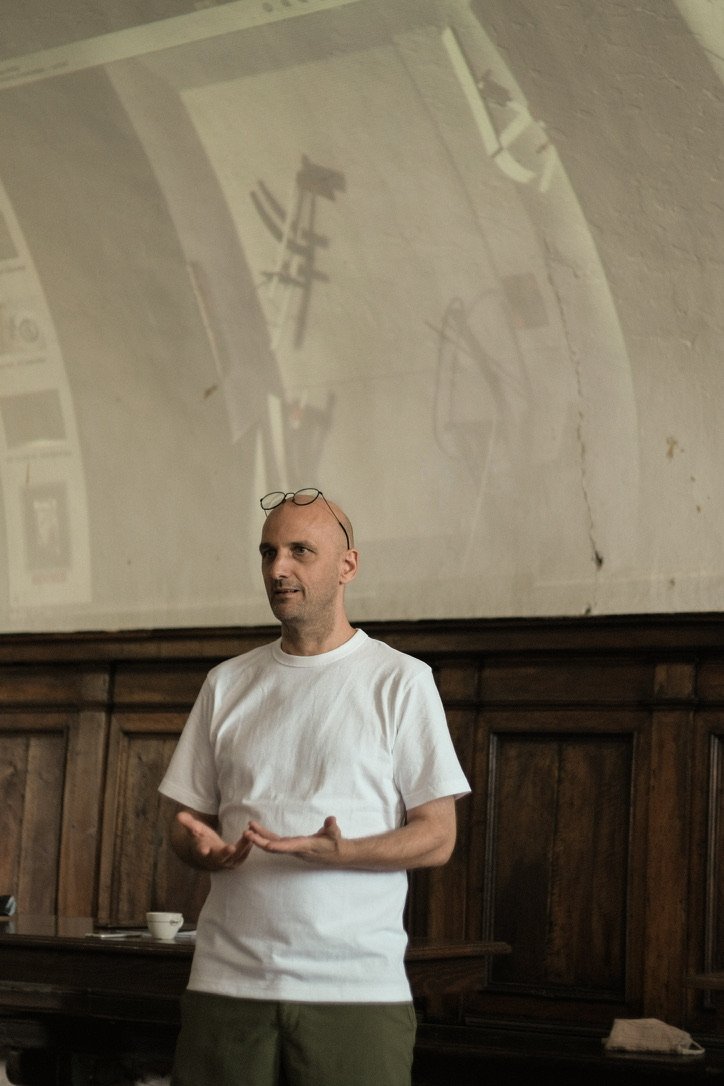
Cinematic lectures
Before and alongside workshops, the CI-Lab cares about sharing its findings with whoever would benefit from it. We believe that verbal descriptions are infinite and limited at the same time so we support our talks with cinematic presentations. The visual extension of our words exposes additional dimensions to dive into far-from-linear logics.
Outcomes
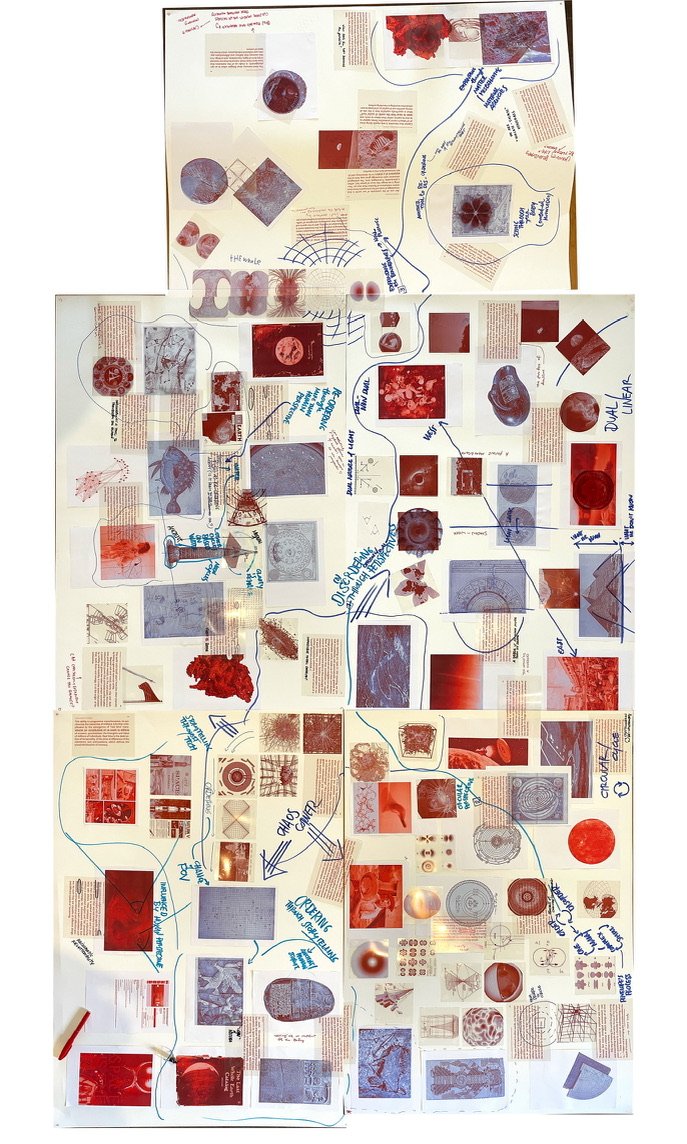
Chimeric collages
The gatherings of visual materials are edited in order to incite incidental combinations but curated to maintain a decipherable coherence and relevance. The elements assemble into a unified object that depicts the multitude of the realities it carries. This is the chimera of the superposed states of a body, a phase space of the transition of the state of matter through which the world went to individuate into a being. It fundamentally paints the dynamic nature of “becoming” rather than a static and solidified “self”. The stitching of many facets aims to emphasise the hyperness of all things.
Who we are
The lab is based in the Netherlands and has no fixed venue: its instances happen wherever its hosts and collaborators are. It is powered by a dynamic team of thinkers, creators and practitioners from diverse fields, including art, architecture, computing and philosophy. The core members are:

Ianis Dobrev
Artist, designer and researcher, and founder of the lab. His project Cnidarian Economics asks how the intelligence of financial systems could be redesigned after ecosystems.
ianisdobrev.com
Andreas Höfert
Research-based designer and UX practitioner based in Vienna, and co-founder of the lab. Explores ecological change, digital life and the entanglements of human and non-human.
andreashoefert.atDelphine Lejeune
Visual artist and material researcher based in Rotterdam. Works with Neo-Craft processes at the intersection of digital imagery, craft and fabrication.
delphinelejeune.comCollaborators and supporters
We work closely with Baltan Laboratories in Eindhoven, with whom we organised the 2025 summer camp, co-curate the content sessions of Raise Your Voice and took part in STRP Scenario. We are part of ARTeCHÓ, the European programme on art, blockchain and decentralised technologies run by SERN, Baltan Laboratories, FZC-Etopia, the Frankfurt School Blockchain Center and MEET Digital Culture Center. The lab is supported by the Stimuleringsfonds Creatieve Industrie, and the 2025 summer camp by EPISTEAM (Horizon MSCA Staff Exchange). More on how the lab is funded.
Join us
Whether you’re an artist, coder, tinkerer, or just curious about exploring the intersection of technology and creativity, we invite you to collaborate, learn, and experiment with us. Let’s push the boundaries of what’s possible, together.
Find out how to get involved, feel free to contact us or explore our ongoing projects and upcoming events.